Plant cell
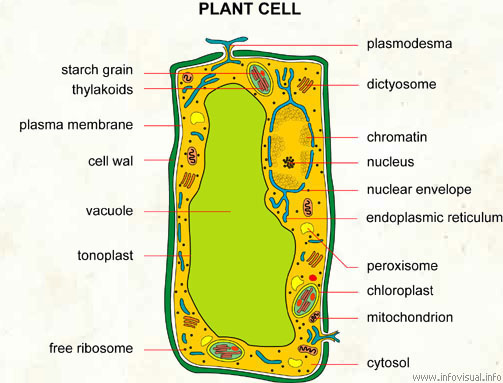
Plasmodesma: intercellular bridge.
Dictyosome: cellular organelle that elaborates sugars and proteins.
Chromatin: a colouring substance in the nucleus of the cell.
Nucleus: small spherical body with the cell nucleus.
Nuclear envelope: membrane surrounding the nucleolus.
Endoplasmic reticulum: a formation within the cytoplasm that plays a role in the production of various substances.
Peroxisome: cytoplasmic organelle which contains enzymes.
Chloroplast: granule of chlorophyll, which is needed for photosynthesis.
Mitochondria: granule that plays an important role in the respiration and energy-releasing reactions in living cells.
Cytosol: liquid part of the cytoplasm.
Free ribosome: cytoplasmic organelle which is responsible for protein synthesis.
Tonoplast: vacuolar membrane.
Vacuole: space with the cytoplasm of a cell containing various substances.
Cell wall: cell wall.
Plasma membrane: envelope of plasma.
Thylakoids: membranous molecular structures involved in photosynthesis.
Starch grain: starch granule.