Urinary system
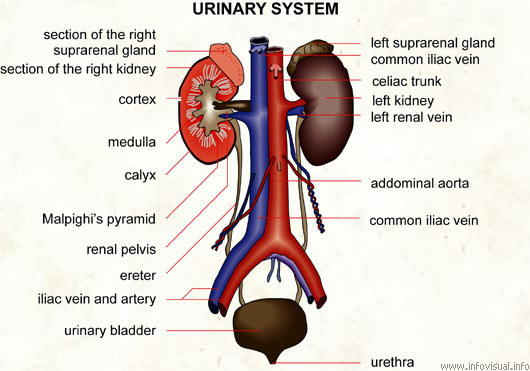
Left suprarenal gland: cap covering the upper part of the left kidney.
Common iliac vein: vein carrying unoxygenated blood from the limbs and lower organs to the heart.
Celiac trunk: branching of the aorta feeding the abdominal viscera.
Left kidney: left blood-purifying organ.
Left renal vein: vein connecting the left kidney and the inferior vena cava.
Abdominal aorta: part of the aorta feeding the organs of the abdomen.
Erethra: small tube through which a human being expels liquid waste.
Urinary bladder: pocket in which urine collects.
Iliac vein and artery: blood vessels in the flank region.
Ureter: tube carrying urine from the kidney to the bladder.
Renal pelvis: part of the kidney situated at the junction of the calyces and leading to the ureter.
Malpighi's pyramid: glomerules of the kidney.
Calyx: excretory cavity in the pelvis of a kidney.
Medulla: matter forming the central part of a kidney.
Cortex: matter of the cortex of the suprarenal gland.
Section of the right kidney: graphic representation of the interior of the right blood-purifying organ.
Section of the right suprarenal gland: graphic representation of the interior of the suprarenal gland.
Photo :
EN : Tongue
lower surface
FR : Langue
face inférieure
ES : Lengua
cara inferior
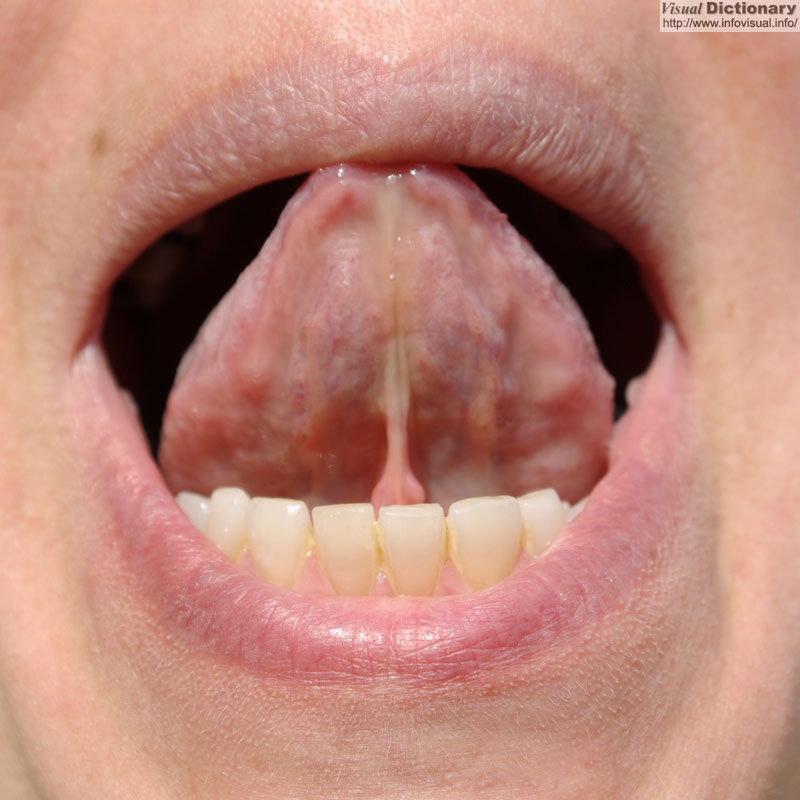
Since the tongue contains no bony supports for the muscles, the tongue is an example of a muscular hydrostat, similar in concept to an octopus arm. Instead of bony attachments, the extrinsic muscles of the tongue anchor the tongue firmly to surrounding bones and prevent the mythical possibility of 'swallowing' the tongue.